International Boxing Rules
This article describes the sporting rules of boxing as applied by national federations around the world, including Russia — judging, the cornerman's role, bout regulations, and anti-doping control. The administrative part specific to the Russian system (tournament admission, sports ranks, the Unified Sports Classification System (EVSK), RUSADA) is covered in a separate article, "Admission, Ranks, and Anti-Doping in Russia".
Judging: the referee's commands and authority
The referee is the only person in the ring during a bout who controls its course; scorecards are kept by the side judges outside the ring, not by the referee. He is required to be at the ring no later than 30 minutes before the start of the tournament's first bout.
 Checking the mouthguard, groin protector, and hand wraps is a mandatory part of the referee's job before every bout.
In the ring the referee gives four commands:
| Command | Meaning |
|---|---|
| "Stop" | the bout must come to a complete halt |
| "Box" | permission to continue/start the bout |
| "Break" | breaking a clinch — both boxers take a step back |
| "Time" | a temporary halt to the bout |
The referee is responsible for the athletes' health and may stop the bout at any moment — in the event of a clear advantage for one of the boxers, an injury preventing continuation, or if, in his opinion, the bout is not being fought in earnest. He may issue a caution, a warning, or disqualify a boxer for unsportsmanlike conduct, including failure to follow his instructions. Before the bout, the referee checks the boxer's full equipment (mouthguard, groin protector, uniform, hand wraps), as well as the presence of the side judges and the doctor at their posts.
If a clear violation causes an injury, the decision is made collectively: if the majority of judges consider the blow legal, the result is a technical loss due to injury; if the blow is considered a deliberate violation, victory is awarded by disqualification; if the violation is considered unintentional, the winner is determined on points, without counting the round in which the injury occurred.
The referee himself is also subject to requirements: he cannot simultaneously be a coach, cornerman, or team official at the same tournament, must undergo a medical examination before competitions above regional level, must have vision no worse than 6 diopters in each eye, and may not wear glasses in the ring (contact lenses only).
The cornerman: rights, duties, and equipment
A boxer cannot enter a bout without a cornerman — if the bout is going very badly for his fighter, and the boxer himself, caught up in the fight, is unable to soberly assess the damage he has taken, it is the cornerman who can stop the bout by throwing a towel into the ring (except during a knockdown count).
A boxer may have up to four cornermen, but only two may go up onto the ring apron, and only one of them may enter the ring itself. The cornerman must work in a tracksuit and may carry only a strictly limited set of equipment: two plastic cups, two clear drinking bottles, two spray bottles, a container for used water, and a towel, plus a bag no larger than 30×20×20 cm containing petroleum jelly, styptic agents, and ice packs for treating cuts. The use of mobile phones and other communication devices at ringside is prohibited.
The cornerman may not shout, clap at the boxer or the referee, appeal to the spectators, give signals during the round, or leave the area allotted to him at the corner of the ring. Violations are punished with a warning, followed by progressive removal — first to the hall, then from the hall for the day of the tournament, and for a repeat violation, for the rest of the competition; for a gross violation, the referee may disqualify the boxer himself.
Bout duration
All boxers — from novices to professionals — fight bouts of 3 rounds with a one-minute break between them; no additional rounds are provided for. The length of each round itself depends on age and level of preparation:
| Age group | Novices | 3rd category and above |
|---|---|---|
| Younger and middle boys/girls (12–14 years) | 1 minute | 1 minute |
| Older boys and girls (15–16 years) | 1.5 minutes | 2 minutes |
| Juniors and adults (17–40 years) | 2 minutes | 3 minutes |
Knockouts and boxer safety
If a boxer is unable to continue a bout after a heavy blow to the head — whether from a knockout or a stoppage by the referee — he may not enter the ring or spar for a mandatory period that grows with each successive knockout:
| Count | Ban on tournaments/sparring |
|---|---|
| First knockout | at least 30 days |
| Second knockout | at least 90 days |
| Third knockout | tournaments — 1 year, sparring — 360 days |
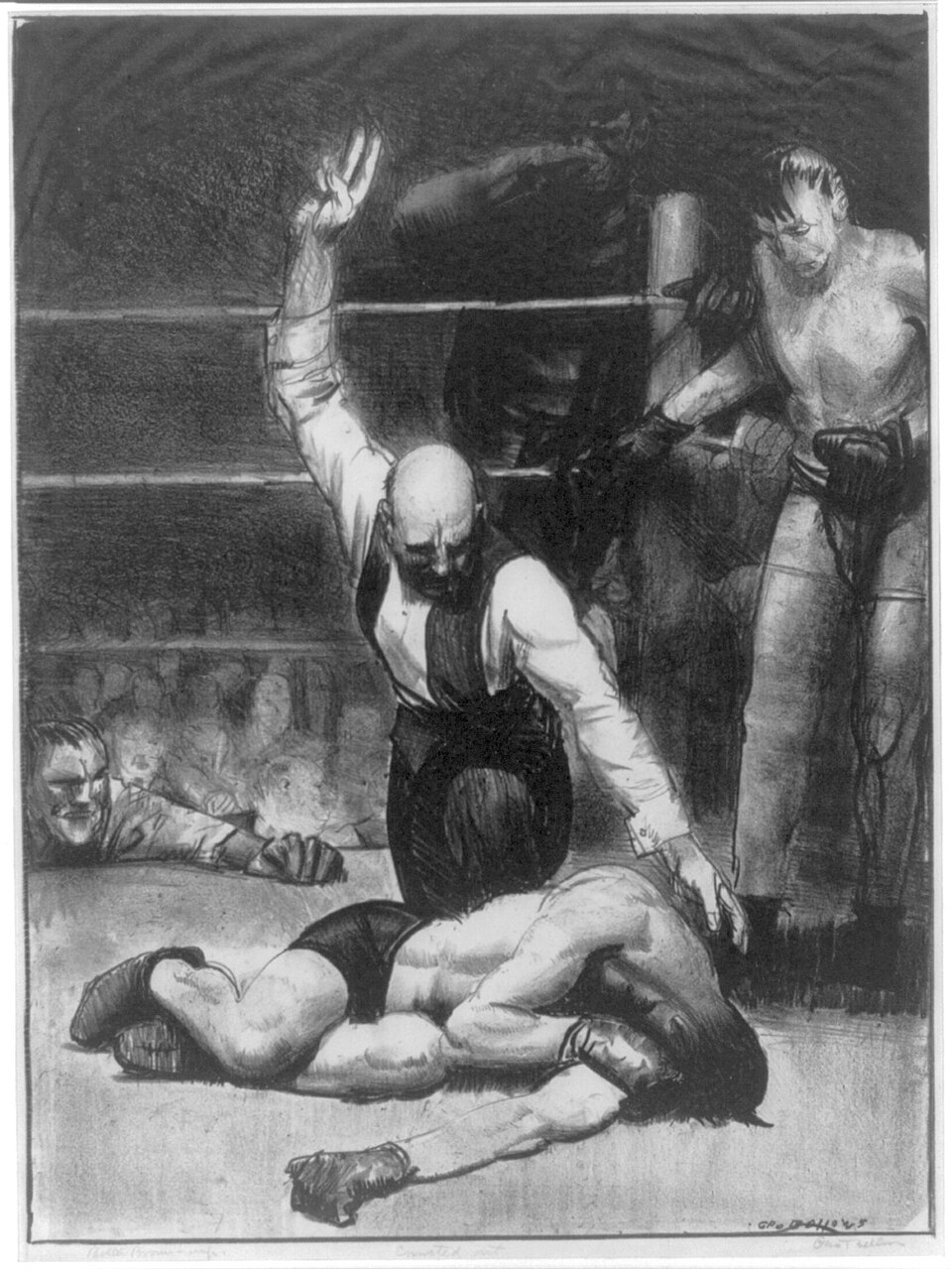 The referee conducts the count on a knockdown — it is his command that registers the knockout and starts the countdown of the suspension period.
This rule applies regardless of how the win was awarded: even if the blow was struck illegally (after a "Break" or "Stop" command) and the boxer was awarded the win by his opponent's disqualification, the knocked-out athlete himself is still suspended for the set period. In the case of a knockout from a body shot, the decision on restrictions is made by the tournament doctor based on his examination.
Weight classes
Boxing divides athletes into weight classes separately for amateurs (by age group, in kilograms) and professionals (17 classes, historically in pounds). A detailed table of all classes is available in a separate article.
Weight Classes in Boxing
A complete list of amateur boxing weight classes by age group and professional boxing weight classes — with pounds converted to kilograms and championship belts.
Read more →Anti-doping control: the World Anti-Doping Code
The international fight against doping in sport is governed by the World Anti-Doping Code (the WADA Code) — the unified set of rules of the World Anti-Doping Agency (WADA), binding on international federations, including boxing. The Code has been in force since 2004 and has been revised several times since; the current version took effect on January 1, 2021. It sets out the list of prohibited substances and methods, the procedure for sample collection, the grounds for anti-doping rule violations, and the sanctions for them — ranging from a warning to a multi-year ban.
Full text: World Anti-Doping Code 2021 (PDF, English) — in case of discrepancies with translations into other languages, including Russian, the English version takes priority. For how this Code is specifically applied in Russia, see the article "Admission, Ranks, and Anti-Doping in Russia".