Kickboxing
Kickboxing is a group of striking combat sports in which athletes combine boxing handwork with kicks. Unlike classical boxing, the attack is built not only around the jab, cross, hooks and uppercuts, but also around strikes with the foot, shin and, in certain disciplines, the knee. This means distance, stance, defense and pace differ noticeably here: an athlete must simultaneously defend the head, torso and legs, switch attack levels quickly, and keep balance after kicking.
In the international WAKO system, kickboxing is divided into two large formats: ring disciplines and tatami disciplines. In the ring, the bout is closer to a full-contact fight with rounds, knockdowns and judges' scorecards. On the tatami, part of the disciplines are built around limited contact, speed, technique and precise scoring rather than around sheer physical pressure.
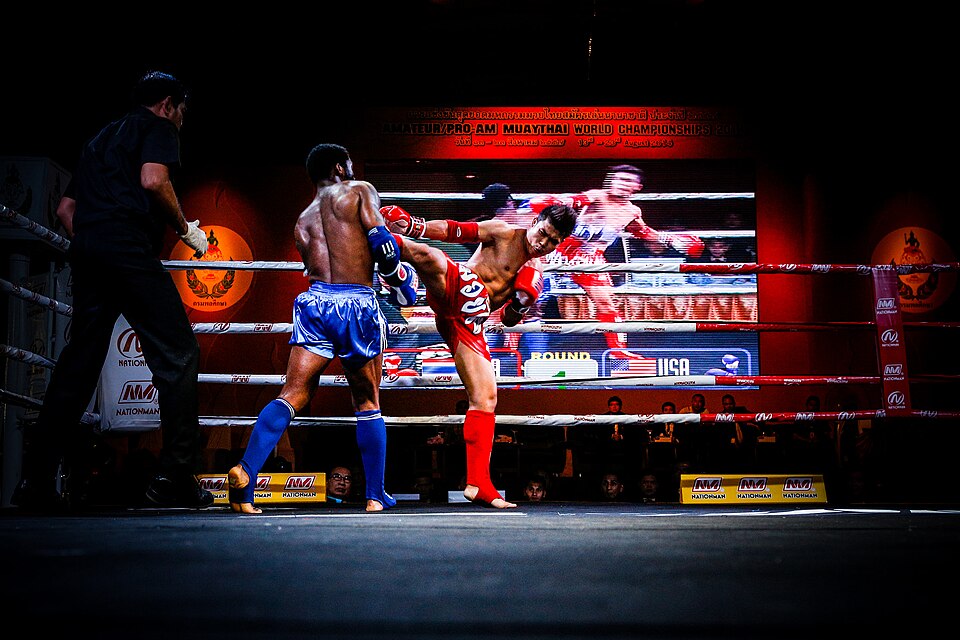 Ring kickboxing looks outwardly close to boxing: ropes, a referee in the ring, judges at ringside and timed rounds. The main difference is that kicking is allowed.
A brief history of kickboxing
Modern kickboxing did not grow out of a single school but from the intersection of several disciplines: American sport karate, boxing, taekwondo, Japanese striking arts and Muay Thai. In the 1960s-1970s, interest grew in the US and Europe in full-contact tournaments where athletes from different schools could compete under clearer sporting rules, with rounds, judges and protective equipment.
In the early period, names such as full contact karate or sport karate were often used. The idea was to move away from demonstration formats and point-stop scoring toward a genuine sporting fight: strikes had to land on target, but safety was ensured by gloves, foot protection, headgear and unified rules.
Key milestones:
| Year | Event |
|---|---|
| 1970 | One of the first bouts took place in the US that WAKO links to the appearance of the term kickboxing in Western sport |
| 1974 | The first major full-contact world championship was held in Los Angeles; early stars included Bill Wallace, Jeff Smith and Joe Lewis |
| 1976-1977 | An international organizational structure for WAKO took shape in Europe; the federation was formally founded in Berlin |
| 1978 | The first WAKO world championship in semi-contact and full-contact was held, still closely tied to karate at the time |
| 1980s-1990s | New disciplines were added, European and Asian schools grew, and modern rules for low kick, light contact and forms took shape |
| 2000s | WAKO strengthened its status as an international sports federation, developed continental structures and anti-doping rules |
| 2018 | The IOC granted WAKO provisional recognition |
| 2021 | The IOC fully recognized WAKO as the international kickboxing federation |
The history of kickboxing therefore looks different from the history of boxing. Boxing has a longer Olympic and professional tradition, while kickboxing is comparatively young: its modern rulebook took shape already in the era of television, international federations, protective equipment and standardized competition.
International organization
The main international organization of amateur kickboxing is WAKO (World Association of Kickboxing Organizations). It runs the international rules, world championships and continental competitions, judging standards, an anti-doping framework, and cooperation with national federations.
WAKO is built as a network of national federations and continental divisions. A national federation is responsible for developing the sport within a country: clubs, coaches, competitions, the national team, selection for international events, and compliance with local sports legislation. Continental structures link national federations to the world level, run regional tournaments and help coordinate the calendar.
| Level | Role |
|---|---|
| WAKO | international rules, world championships, judging standards, anti-doping, recognition and overall strategy |
| Continental divisions | continental championships, regional development, links between countries and the world office |
| National federations | licensing, domestic calendar, national teams, coaches, judges and disciplinary procedures |
| Clubs and schools | day-to-day training of athletes, entry-level competitions, work with children and amateurs |
IOC recognition does not mean kickboxing is already part of the Summer Olympic program. It is an institutional status for the international federation: WAKO is recognized as an organization that can represent the sport within the Olympic system, but including a specific discipline in the Games program requires a separate decision on quotas, format and calendar.
How kickboxing differs from boxing, karate and Muay Thai
Kickboxing shares handwork, basic defense, footwork, rounds and judged scoring with boxing. But an unadapted boxing stance is dangerous here: too much weight on the lead leg opens it up to a low kick, and an upright torso without readiness for kicks leaves an athlete vulnerable at mid and long range.
From karate, kickboxing inherited part of its kicking technique and the competitive culture of tatami bouts, especially in point fighting and light contact. But the ring disciplines of kickboxing are closer to boxing and Muay Thai: pressure, combination work, physical resilience and the ability to fight several rounds under sustained contact all matter there.
Kickboxing is often confused with Muay Thai because of kicks and knee strikes. The difference lies in the rules: in classical Thai boxing, the clinch, elbows, sweeps and a specific way of scoring strikes carry great weight; in WAKO K-1, knees and a limited clinch are allowed, but there is no full Thai clinch or elbows. In full-contact and low kick, knees are not part of the basic arsenal at all.
Ring disciplines
Three main disciplines are contested in the ring under WAKO: full contact, low kick and K-1 Style. All of them involve real contact, glove work, protective equipment, and victory by points, knockout, technical knockout, opponent's retirement or disqualification.
| Discipline | What is allowed | Practical meaning |
|---|---|---|
| Full contact | Punches and kicks above the belt | The format closest to classical American kickboxing: a lot of boxing, high pace, emphasis on combinations and kicks to the body/head |
| Low kick | Full contact plus kicks to the thigh | A tougher format: the athlete must be able to defend the lead leg, answer with low kicks, and stay mobile under load |
| K-1 Style | Punches, kicks and knee strikes, limited clinch work | The most versatile WAKO ring discipline: closer to modern professional kickboxing, but without elbows or a full Muay Thai clinch |
In a ring bout, four factors usually decide the outcome: clean landed strikes, effectiveness of attacks, defense and control of the fight. Simply moving forward without accurate strikes should not automatically win a round. As in boxing, judges score not noise but effective actions: clean strikes that reached a legal target and were not blocked.
Tatami disciplines
Tatami disciplines take place on a mat, without ropes. There is less room for physical pressure against the ropes here, and more weight falls on entries and exits, the speed of the first action, distance control and technical cleanliness. In the WAKO system, the tatami disciplines are point fighting, light contact, kick light and forms.
| Discipline | Format | What matters |
|---|---|---|
| Point fighting | A bout with stoppages after scoring actions | Explosive speed, the first accurate strike, distance, reaction and tactical deception |
| Light contact | Continuous fighting with limited striking power | Technique, pace, volume of work and control of power, without the aim of causing maximum damage |
| Kick light | Light contact plus strikes to the thigh | A transitional format between tatami and ring: keeps contact control but adds low-kick work |
| Forms | A demonstration discipline without an opponent | Coordination, acrobatics, technique, rhythm and artistry of performance |
Tatami does not mean "easy sport." In point fighting, a split-second mistake immediately gives the opponent a point. In light contact and kick light, an athlete must work quickly and with variety while keeping control of power: rough contact can lead to a warning or a point deduction.
Weight and age categories
Weight categories in kickboxing depend on gender, age and discipline. In adult men's ring disciplines, WAKO generally uses a scale from lightweight to super heavyweight, while women have a separate, more compact scale. Children, cadets and juniors have more categories, because a difference of a few kilograms at that age has a greater effect on safety and fairness between opponents.
The principle is similar to boxing: an athlete must weigh in and meet the declared limit. But comparing boxing and kickboxing categories directly is not valid: different federations, disciplines and age groups use their own tables.
| Group | How to read the categories |
|---|---|
| Children and younger cadets | Smaller steps between categories, a finer grid for safety |
| Older cadets and juniors | Categories approach the adult scale but still account for age-related development |
| Adults | The main competitive scale for national, European and world championships |
| Veterans | Separate age groups where safety and appropriate matchmaking become the priority |
Current limits should always be checked against the applicable regulations of a specific tournament: WAKO regularly publishes rule updates, and national federations may apply transitional versions for their own competitions.
Equipment and safety
Basic equipment depends on the discipline, but almost always includes gloves, a mouthguard, groin protection, hand wraps and a uniform. Ring disciplines add headgear for certain ages and levels, plus shin and foot protection in formats where the regulations require it. On the tatami, equipment is especially important because of the large number of fast entries and exits: athletes often work in combinations, where foot, shin and head protection reduces the risk of accidental injury.
The referee is responsible for safety in the moment: stopping the bout in the event of fouls, knockdowns, injuries, a clear advantage, or a loss of the ability to defend. The competition doctor can bar an athlete from a bout or withdraw them from the tournament after an injury. Requirements are generally stricter for children and juniors: less tolerance for hard contact, and more attention to equipment and an athlete's condition after taking strikes.
A separate anti-doping framework applies as well. International WAKO competitions are subject to anti-doping rules, while domestic events fall under the rules of the national anti-doping organization and the country's sports legislation.
Judging and victory
In ring disciplines, the fight is scored by ringside judges while the referee controls the action in the ring. Victory can be awarded on points, early by knockout or technical knockout, by the opponent's retirement, by the doctor stopping the fight, or by disqualification. In a close, tight fight, clean landed strikes, activity, defense and who controlled the round better are decisive.
In point fighting, the logic is different: a scoring action is registered, the bout is stopped, the judges award points, and the fight then continues. In light contact and kick light, the fight runs continuously but with limited striking power; what matters there is not "outhitting" the opponent but outplaying them technically and tactically within the permitted level of contact.
Fouls include strikes to prohibited areas, attacks after the referee's command, dangerous head actions, holds beyond the permitted time, rough contact in the light disciplines, passivity, simulation and unsporting conduct. Sanctions range from a verbal warning to a formal warning, point deductions and disqualification.
The amateur athlete's pathway
An amateur career usually begins with club and city-level events. Regional competitions follow, then national championships, international tournaments, continental championships and world championships. At this level, what matters is not only winning but also consistency: an athlete must be able to make weight, fight several bouts in one tournament, recover between fights and adapt to different opponents' styles.
The training process is built around several blocks:
- boxing fundamentals — stance, footwork, punches, defense, counterattack;
- kicks — front kick, side kick, high kick, low kick, middle kick, spinning kicks;
- hand-and-leg combinations — transitioning from boxing to kicks without losing balance;
- leg and body defense — blocks, evasions, returns, distance control;
- physical conditioning — rounds, explosive work, recovery, strength endurance;
- tactics — choosing distance, pace and the set of strikes suited to a specific discipline.
A versatile athlete can compete in several disciplines, but at the top level specialization is almost inevitable. A point fighter needs explosive speed and precision on the first action; a K-1 fighter needs resilience under pressure, combination work, and defense against low kicks and knees; a light-contact athlete needs volume, control of power and discipline.
Professional kickboxing
Professional kickboxing follows a different logic than the amateur sport. An amateur may fight several bouts in a single tournament, sometimes one bout per day. A professional usually prepares for a specific opponent, fights less often, and builds a career through promotions, rankings, titles and contracts.
The most recognizable professional formats are close to K-1: punches, kicks and knee strikes, high pace, an emphasis on spectacle and a clear television picture. At the same time, the rules of different promotions can differ: some allow a short clinch, others restrict holds more strictly, and sweeps or knee work may be interpreted differently. For this reason, professional experience cannot automatically be carried over into an amateur WAKO tournament without adapting to its regulations.
What to remember
Kickboxing cannot be summed up in the single phrase "boxing plus legs." It is a set of disciplines with different logics: full contact, low kick and K-1 test a fighter in the ring; point fighting, light contact, kick light and forms develop speed, technique, control and precision on the tatami. So when choosing a tournament, a club, or a training goal, it is important first to understand the discipline, the contact rules and the equipment requirements, and only then compare weight categories and the level of opponents.